
Copyright 2015 Tez Miller
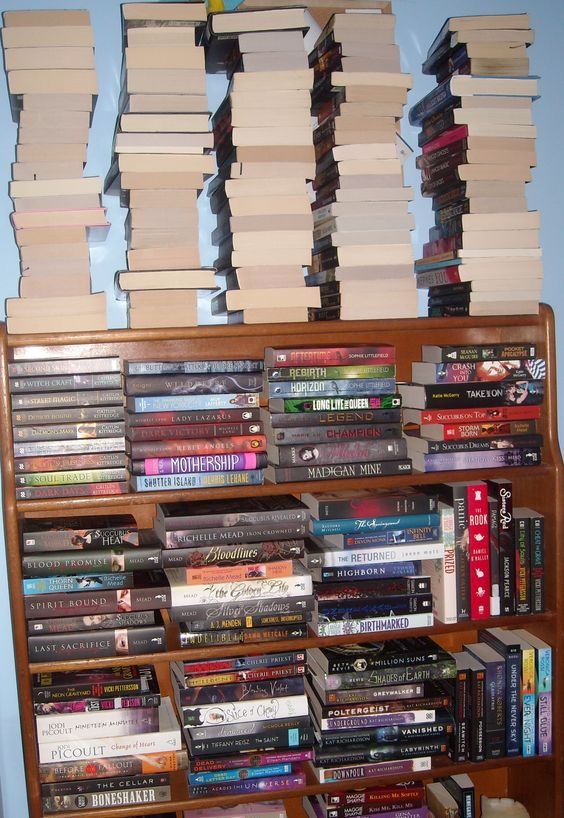
You see this here? Other than an alphabetically-arranged-by-author shelf of books, what you may not know is…they’re all unread.
They’re not alone. I currently own 381 unread books, which have come from various sources — bought new, bought second-hand, from the publisher, from the author. And because I prioritize reading library books with their due dates, my own books remain unread…and grow in number.
Add those in with the books I’ve already read, or no longer want to read, and what I have are TOO MANY BOOKS.
Culling books is theoretically simple. Strangely enough, the easiest part is deciding which books to dump. I started with about 130 unwanted books, both read and unread — I rarely keep any books I’ve read, unless they’re author-signed or galleys.
Galleys are the hardest to part with because finding recipients is difficult. You can’t re-sell them, so the best you can hope for is someone willing to pay for postage. (Yes, I’m trying to release these books at no expense to me). Goodreads groups showed no interest. #BooksForTradeAU on Instagram and Twitter resulted in nothing. Last year I donated some stacks to the annual local fête, but still have some left — and months away from the this year’s event, they’re not taking donations at the moment.
Regular books, as opposed to galleys, also face challenges. Ideally, I’d offload everything to my local library — they’ve given me so much over the years.
But this is Australia. My local library doesn’t accept book donations due to the cost required to pay people to clear-cover books to help them last longer. I checked with a friend in another state, and their library has the same policy. So this could actually be an Australia-wide problem (Other countries may not face this challenge, though. So if your local does accept book donations, go for it!).
Another friend in my state prepared to send her books in two directions. One section would go to a prison project, and here’s where things get tricky: in both fiction and non-fiction, there are some subjects the prison project won’t allow (maybe violence). I read a lot of dark stuff, and struggle to remember even character names from last month’s reading. And I also can’t send through books I haven’t read, because I don’t know what’s in them.
Her other section would go towards the Brotherhood of St Laurence, a charity that has a special website dedicated to bookselling. The profits go to the charity, and book donations are accepted. They’ll even come to your home to collect your offerings. But that would mean acquiring boxes. And what happens to their unsold stock?
If it seems like I’m over-complicating this entire situation…you’re probably right. 😉
What’s worked best for me so far? eBay. If you’re concerned about me making money from selling these books, money of which the authors won’t make a cent, don’t worry — I don’t make a cent either. I charge $8.30 for a prepaid regular 500g satchel made of plastic – packaging and postage all in one. I open the auction at 95 cents. eBay’s seller fees are commission based on the all-up selling price, including postage. I rarely get more than one bidder. And does PayPal take a commission on incoming payments? If anything, I’m LOSING money selling these books, so I’m not profiting. But the books go directly to people who actually want to read them, so I’m not just offloading them onto someone else to deal with.
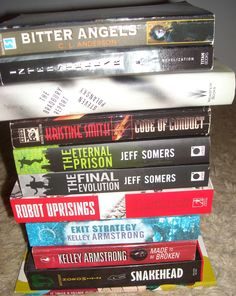
My eBay process: start a file (I use Word). Include the author, title, year of publication, the ISBN, and the summary of each book. Make notes about each book’s condition: such as if the pages are yellowing with age, if there are remnants of bookshop stickers you can’t remove, pen marks on pages, etc.
Also, save an image of each book’s cover — there is where the ISBN comes in, as using it will help you find the correct edition’s cover online. Problem: when your edition is apparently so rare that you can’t find any images of it. Then you’ll have to photograph your own book (Which I tried and failed to do, because my camera and phone both refuse to connect to either my laptop or PC. Thankfully, only two or three books are in this situation).
Copyright 2016 Tez Miller
My list is arranged by author surname, then chronologically by release year. This makes it easier to find a specific book, and delete it from the file once I’ve sold it. eBay lets you automatically relist a book three times, and then you must manually relist it (if it still hasn’t sold). And relisting has resulted in sales for me. Still so many to go, of course.
Note: I strongly recommend using all the information — including photos — you’ve saved, as sometimes letting eBay fill in the details can result in your books listed in the wrong categories.
It’s now August. I started with about 130 books to shed. I’ve successfully sold 13 on eBay in the past year. But I still need to cull 117 books, including ARCs and signed copies. But it sure beats having to find boxes and then making the books other people’s problems.
What are your favorite venues for culling your collections? How many books to you need to lose? And how many unread books do you own? 😉